

UAE travel insurance rollout explained: What it means for your next international trip
Coverage includes medical emergencies, disruption support and limited-term automatic eligibility
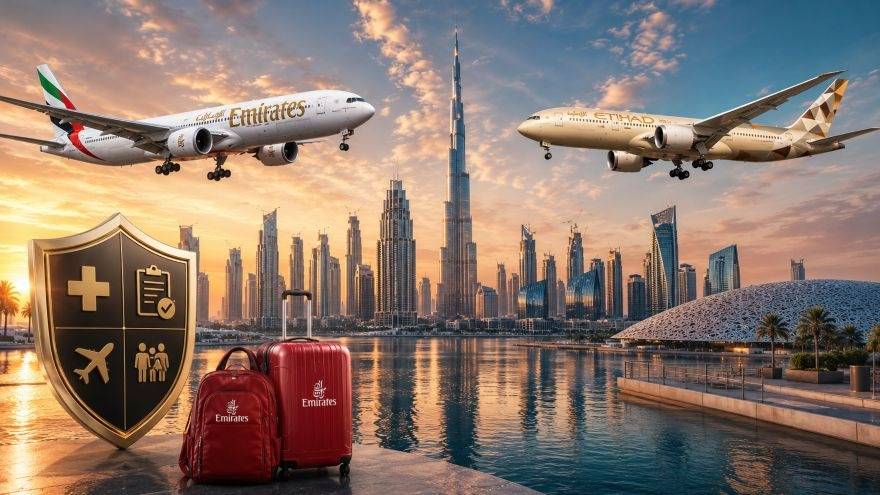
DUBAI – A major shift in airline-backed protection is unfolding in the United Arab Emirates (UAE), with both Etihad and Emirates rolling out expanded travel insurance schemes aimed at international passengers.
The initiatives come at a time when global travel demand is rebounding but remains sensitive to regional uncertainty and rising medical costs abroad. For travellers, the changes mean insurance is increasingly being bundled directly into the ticketing experience rather than purchased separately. The result is a new model where coverage, disruption support and medical assistance are becoming part of the flight itself.
The latest developments signal a broader repositioning of how airlines compete for international tourism flows into the UAE. Instead of focusing solely on fares and routes, carriers are now integrating safety nets that address medical emergencies, disruptions and geopolitical risks. This marks a notable change in what it means to book a flight to the region, particularly for long-haul and first-time visitors.
Etihad coverage
At the centre of this shift is Etihad Airways, which has partnered with Abu Dhabi’s Department of Culture and Tourism to provide complimentary medical travel insurance for eligible passengers. The cover applies automatically to qualifying bookings made between July and December and lasts for up to 15 days in the UAE. It is underwritten by Daman, part of the wider UAE healthcare ecosystem, and applies to visitors arriving on Etihad-operated services or those transiting through Abu Dhabi under specific conditions.
The inclusion is automatic, meaning travellers do not need to submit separate applications. However, the policy has clear limitations, including exclusion of pre-existing medical conditions, which means passengers with chronic illnesses may still require additional private coverage.
For many global travellers, the most immediate change comes through Etihad’s automatic insurance inclusion. Eligible passengers booking international tickets with a UAE stopover or arrival in Abu Dhabi will receive medical cover for emergency treatment during their stay. The initiative also extends to travellers who purchase tickets outside the UAE, provided they meet the eligibility criteria linked to stopovers or entry points.
The insurance window of 15 days effectively covers short-term tourism stays, which represent a large share of inbound visitors. It is designed to remove friction at the booking stage and strengthen Abu Dhabi’s positioning as a seamless travel destination.
The scheme also reflects a wider tourism strategy by Abu Dhabi to integrate travel, healthcare and visitor experience into a single package. Attractions such as Yas Island, Saadiyat Island and cultural landmarks are being supported by infrastructure that now includes embedded medical protection.
Emirates travel insurance
In parallel, Emirates has introduced a more comprehensive travel insurance offering that extends beyond standard medical cover. Its policy includes protection for conflict-related medical incidents, a feature that sets it apart from many traditional travel insurance products.
Backed by Travel Guard, the Emirates scheme also includes airline-managed hotel accommodation and extended-stay assistance when flights are disrupted due to events such as airspace restrictions or regional instability. In certain cases, passengers may also be rebooked on alternative airlines at no extra cost, ensuring continuity of travel even during large-scale disruptions.
The policy is available in multiple markets including the UK, Germany, France, Canada, Singapore, South Africa and several Gulf and European countries. Emirates has also linked the product to customer feedback, with its leadership stating that demand for travel continues but expectations around protection have increased significantly.
Unlike traditional insurance models, this approach combines financial cover with operational support, meaning the airline takes a more active role in managing passenger welfare during disruption scenarios.
What it means for global travellers
The rollout of airline-led insurance reflects a wider push to rebuild confidence in international travel, particularly during periods of regional tension and fluctuating advisory warnings. Industry specialists note that medical emergencies remain one of the most common causes of travel insurance claims globally, accounting for a significant share of costs each year.
For passengers, the practical implication is that insurance is becoming more embedded in the travel process itself. This reduces the need for separate policies in some cases, but experts continue to advise travellers to review coverage carefully, especially where pre-existing conditions or long-term health needs are involved.
Insurance professionals have also highlighted that airline-provided policies tend to focus on emergency care rather than full medical treatment or ongoing conditions. As a result, travellers with specific health risks may still need supplementary coverage to avoid gaps.
For global visitors, the combined effect of Etihad and Emirates’ initiatives is a reshaping of expectations around what a ticket to the UAE includes. Travel is no longer defined solely by transport and accommodation, but increasingly by bundled protection against medical and logistical disruption.
As bookings rise for upcoming holiday seasons, especially winter travel, the presence of embedded insurance is expected to influence how travellers choose destinations, particularly those seeking greater certainty in an unpredictable global travel environment.